LDL Cholesterol Levels

What is cholesterol?

Although you’ve probably heard the words “high cholesterol” used many times, you may still wonder what cholesterol is.

Cholesterol is a fatty, waxy substance (also called a “lipid”) that’s produced by the liver and is found in your bloodstream. It’s also found in foods high in saturated fat like fatty meats, egg yolks, shellfish, and whole-milk dairy products.

And, although cholesterol is a vital part of the structure and functioning of your cells, it can be harmful to your health when there’s too much of it in your blood.

How to find out if you have high cholesterol

Although you usually don’t feel symptoms of high cholesterol, having high cholesterol is a health factor that shouldn’t be ignored.

Whether or not you have high cholesterol depends in part on your family history (genetics). But it also involves certain lifestyle factors. Eating a lot of fats and not getting enough exercise can cause your cholesterol level to rise.

There are 3 main components doctors evaluate when you have a blood test to check your cholesterol levels:

  • LDL cholesterol, commonly referred to as “bad” cholesterol.
  • HDL cholesterol, commonly referred to as “good” cholesterol.
  • Triglycerides are another fat produced by the liver and also found in food.

Having the right levels of each of these substances is important to your health.

What is LDL cholesterol?

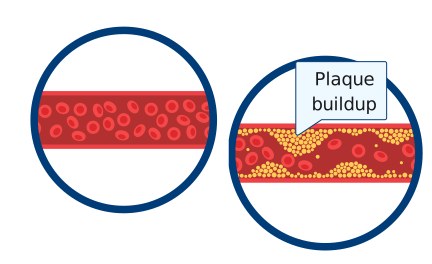
“LDL-C” stands for low-density lipoprotein cholesterol. It’s referred to as “bad” cholesterol in part because it’s one of the major building blocks of plaque buildup in the arteries. Plaque is a thick, hard fatty deposit that can clog arteries and make them less flexible.

Why too much LDL cholesterol is unhealthy?

LDL-C makes up the majority of the body’s cholesterol. When LDL-C levels are high in the bloodstream, cholesterol/plaque may build up in the wall of the artery, resulting in a progressive disease called atherosclerosis.

As a rule, you want to keep your LDL cholesterol low.

HDL cholesterol is considered the “good” cholesterol

“HDL-C” stands for high-density lipoprotein cholesterol. It is called “good” cholesterol, in part because it helps keep some cholesterol from building up in the arteries.

Why HDL cholesterol is beneficial?

HDL cholesterol acts like a scavenger, say experts, because it carries the “bad” LDL cholesterol away from the arteries and back to the liver. Once in the liver, cholesterol is then broken down and flushed from the body.

It is estimated that HDL carries one-fourth to one-third of blood cholesterol. This is why it’s so important to maintain healthy levels of HDL.

Understanding Cholesterol Levels

It’s important to know what your cholesterol and triglyceride numbers are and what they mean. The table here gives you a general idea of what levels are considered high, low, and optimal.

Click on the tabs below to view the cholesterol level guidelines.

Source: National Cholesterol Education Program (NCEP) Adult Treatment Panel (ATP) III, 2002.

Managing high cholesterol

Depending on your medical history and health, managing high cholesterol may be different for you. Your doctor will look at your results, and will use this information along with your medical background, to establish a cholesterol goal for you.

By understanding what your cholesterol numbers and your cholesterol ratio are, based on your complete health history, you can work with your doctor to help manage your cholesterol levels.

Plaque buildup in the arteries

Plaque buildup is formed out of fatty deposits and other cells that can collect in the walls of your arteries over time. As plaque continues to build up, it can actually narrow or begin to clog the arteries.

The buildup of plaque in arteries often starts in early adulthood. It is a progressive disease, called atherosclerosis, that causes the wall of the artery to become thicker.

One major cause of atherosclerosis is a high level of “bad” LDL cholesterol.

Other risk factors in addition to high cholesterol

What many people don’t realize is that there are other risk factors that contribute to plaque buildup in arteries and atherosclerosis. These include:

  • Diabetes
  • High blood pressure
  • Family history of early heart disease
  • Age
  • Obesity
  • Smoking

If you have high cholesterol plus any of these other risk factors, you could be at increased risk for plaque buildup in arteries, which is why getting your “bad” LDL cholesterol to goal is so important.

other risk factors

INTERESTED IN SAVINGS ON CRESTOR?

Learn more about several ways to save on your prescription.

START SAVING

IS CRESTOR RIGHT FOR YOU?

Talk to your doctor to find out if CRESTOR is right for you.

Is Crestor Right for You?

IMPORTANT SAFETY INFORMATION ABOUT CRESTOR TABLETS

  • CRESTOR is not right for everyone.
  • Do not take CRESTOR if you have liver problems or are allergic to rosuvastatin or any of the ingredients in CRESTOR.
  • Call your healthcare provider right away if you have unexplained muscle pain or weakness, especially with fever; have muscle problems that do not go away even after your healthcare provider told you to stop taking CRESTOR; feel unusually tired; or have loss of appetite, upper belly pain, dark urine, or yellowing of skin or eyes. These could be signs of rare but serious side effects.
  • Your healthcare provider may do blood tests to check your liver before starting treatment and if you have symptoms of liver problems while taking CRESTOR.
  • CRESTOR may cause you to have protein and blood in your urine.
  • Elevated blood sugar levels have been reported with statins, including CRESTOR.
  • The most common side effects may include headache, nausea, muscle aches, weakness, and constipation.
  • Tell your healthcare provider about all the medicines you take, including prescription and over-the-counter medicines, vitamins, and herbal supplements. CRESTOR may affect the way other medicines work, and other medicines may affect how CRESTOR works.
  • Tell your healthcare provider if you are pregnant or may become pregnant. CRESTOR can pass in breast milk and may harm your baby. Do not breastfeed while taking CRESTOR.
  • Talk to your healthcare provider for more information about CRESTOR.

Approved Uses

  • Prescription CRESTOR is used:
    • to reduce the risk of major adverse cardiovascular (CV) events, such as death from cardiovascular disease, heart attack, stroke or the need for procedures to improve blood flow to the heart called arterial revascularization in adults who do not have known heart disease but do have certain additional risk factors
  • CRESTOR is used along with diet to:
    • lower the level of low-density lipoprotein cholesterol (LDL-C) or “bad” cholesterol in adults with primary hyperlipidemia
    • slow the buildup of fatty deposits (plaque) in the walls of blood vessels
    • treat adults and children 8 years of age and older with high blood cholesterol due to heterozygous familial hypercholesterolemia (HeFH), an inherited condition that causes high levels of LDL-C
    • along with other cholesterol lowering treatments or alone if such treatments are unavailable in adults and children 7 years of age and older with homozygous familial hypercholesterolemia (HoFH), an inherited condition that causes high levels of LDL-C
    • to treat adults with primary dysbetalipoproteinemia (an inherited condition that causes high levels of cholesterol and fat) or hypertriglyceridemia

Please read the Patient Information and full Prescribing Information.

You may report side effects related to AstraZeneca products.

References:

  • 1a 1b 1c 1d CRESTOR® (rosuvastatin) [prescribing information]. Wilmington, DE: AstraZeneca Pharmaceuticals LP; 2024.
  • ^ Lipitor® (atorvastatin calcium) [prescribing information]. Morgantown, WV: Viatris Specialty LLC, 2024.
  • ^ Zocor® (simvastatin) [Prescribing Information]. Jersey City, NJ: Organon & Co.; 2023.
  • ^ Davidson M, Ma P, Stein EA, et al. Comparison of effects on low-density lipoprotein cholesterol and high-density lipoprotein cholesterol with rosuvastatin versus atorvastatin in patients with type IIa or IIb hypercholesterolemia. Am J Cardiol. 2002;89:268–275.
  • ^ Schwartz GG, Bolognese MA, Tremblay BP, et al. Efficacy and safety of rosuvastatin and atorvastatin in patients with hypercholesterolemia and a high risk of coronary heart disease: A randomized, controlled trial. Am Heart J. 2004;148:e4.
  • ^ Olsson A, Istad H, Luurila O, et al. Effects of rosuvastatin and atorvastatin compared over 52 weeks of treatment in patients with hypercholesterolemia. Am Heart J. 2002;144:1044-1051.

Reference:

^ Data on File, US-62651. AstraZeneca Pharmaceuticals LP.

This site is intended for US consumers only.

IMPORTANT SAFETY INFORMATION AND APPROVED USES FOR CRESTOR TABLETS

SEE MORE